My thoughts on all things health and wellbeing. Contact me for writing services and visit my main website www.laurenscloud.com
lauren.bishop123@btinternet.com
Like most of my posts, the title of this one pays homage to
a song lyric, but it also references the best book I’ve read in a long time: Happy by Derren Brown.This masterpiece gives the reader a
whistle-stop tour of the history of happiness philosophy, and provides some simple
insights and advice that can help us to live happily. I’d like to share some of
those thoughts here.
When it comes to happiness (or indeed lack thereof), the problem
that we have in modern Western society is our fierce attachment to the ‘hedonic
treadmill’: we are led to believe that possessions, people, fitness crazes,
holidays, TV shows, etc etc, will bring us happiness. We buy the latest iPhone
and experience a fleeting joy, until the next model comes out and we are left
wanting again. This is because possessions do
not bring real, lasting happiness. Similarly, neither do holidays or
relationships.
Why is this? As the ancient Bhuddist saying states:
“Wherever you go, there you are”. Possessions, relationships and holidays never
bring true contentment, because whatever we buy, whoever we spend time with,
whatever our material riches and however many luxury holidays we take, we are always ourselves.
That we can never escape our own bodies and minds is a
somewhat terrifying thought, but a liberating and insightful one too. Once we
realise the significance of this fact, it is a powerful tool for cultivating
contentment. If I’m not happy at home, chances are I won’t be happy in an
exotic beachside location, because I’ll still be me. So, the solution is to
become more ok with myself. This is the only path to true peace and happiness.
I’d like to take this opportunity to draw your attention to
a video that describes wonderfully the distinction between the fleeting joy
that things, people and positive life events bring, and that robust happiness
that can be located and nurtured within. Tara Brach is a psychologist and a
mindfulness teacher, and offers great insight into the world of true happiness.
Feel free to take some time to close your eyes, relax and listen to her wise
words.
Becoming more ok with ourselves, and therefore connecting
with our inner happiness – which, by the way, we all have the capacity for –
involves being open and accepting of our experiences, both positive and
negative. We have a tendency to believe that happiness is linked with not
experiencing pain, suffering or negative events, so we try to avoid such
experiences. Although counter-intuitive, avoiding difficult thoughts, feelings
and events isn’t the answer. It’s part of the human condition that we will all
experience challenges across the life-course, and it’s human nature to have
fluctuations in mood and energy levels. Rather than beating ourselves up about
this, we do better to acknowledge and accept our experiences in any given
moment, whatever they are.
If this notion seems contradictory and counter-intuitive,
that’s fair enough – it kind of is! – but even so, I hope you will be willing
to give it a go and see how it impacts on your life. A good starting point
might be to try some guided meditation practices – you’ll find loads of these
by searching online - personally I can recommend the Dorset Mindfulness Centre’sSoundcloud page. These practices can help you to connect with your thoughts and
feelings and become more accepting of them, which in turn can help you to
experience a sense of inner peace and contentment; in other words, true
happiness.
In sum, happiness isn’t about running away from life’s
difficulties, but turning towards them and becoming more ok with ourselves. This
is vital, since you are always you, no matter where you go or what you do.
Instead of relying on external objects, people and places for comfort, we can
find it by connecting with, getting to know, and coming to be ok with, our
internal worlds.
I’d like to finish by quoting Leona Lewis’s song about
happiness, which sums up these ideas quite nicely:
One of my favourite things about this time of year is
listening to Christmas music.Over the
last few years I’ve really enjoyed Leona Lewis’s album Christmas, With Love,
which delivers the perfect balance of fun and lower-tempo songs, originals and
classics, and really showcases lots of different sides of her personality and
musical talent.Anyway, one of the
slower tracks on the album is Your Hallelujah, a beautiful, emotionally charged
song.I was driving home from work the
other day and found myself almost in tears when the song came on, which
compelled me to write a few words about the song and what it means to me.
The song, for me, brings absent loved ones to mind.Not just my own, but others’ too.In fact, the first time I heard it was around
the time I’d found out a colleague had lost his dad.I didn’t even know the guy that well and he’d
probably think it a bit strange if he knew this, but I felt quite affected by
the incident and wished there was something I could’ve done to help.I remember thinking of this guy and his
family when the song came on, and now it reminds me of other people whose absence
is always felt more at this time of year.
Remembering lost loved ones at Christmas
The first verse and chorus of Your Hallelujah go like this:
Winter's cold, in the light
Somebody's waiting
Feel the warmth, safe and sound now
All the joy, all the fears
You can let go now
Watch the snow gently fall down
Someone needs you
Someone loves you
Hallelujah
Now you're coming home
Hallelujah
Angels calling out to you
You can hear them sing your hallelujah
These lyrics, along with the beautiful melody, strike a
chord with me and make me feel a little more connected to those I know who are
no longer with us.I envisage those
people at peace, and wish a little that they were coming home as the song
suggests.In my post Save You I talk of
a chap I knew who had recently taken his own life, and how I wished, as most of
us do in these situations, that he could have known how many people would have
begged him to stay.The lyric someone
needs you; someone loves you reminds me that we should always make sure the
people around us know how much we value them.
So, at this time of year, I feel it’s really important to tell
and show our friends, family, admired acquaintances, inspiring colleagues, and
any other important people in our lives, that they are important to us.That we need them and love them.And this has also got me thinking of those
people who are unfortunate enough not to have any loved ones to celebrate
Christmas with.When I see homeless
people in the street, particularly around Christmas, I occasionally sit and
have a chat with them as I think sometimes this might be more needed than a few
coins or a coffee - well, actually, a chat AND a coffee is my preferred offering!
– just to give them a feeling that they are valued; they are needed as much as
anyone else in this world.I hope I’ll
find some time this year to spread some festive cheer to the less fortunate
members of my local community, perhaps even by doing some volunteering with the
Salvation Army or some such organisation.
To sum up, I’m making a big effort this Christmas to make as
many people around me as possible feel needed and loved.Spending as much quality time with friends
and family as I can, making sure they know how grateful I am to have that time
with them, and extending some of that kinship to those who may be lonely.I love that by doing this I will be lifting
my own spirits as well as that of those around me (hopefully!) and hope that
you will all do the same and have a very Merry Christmas :)
Hello readers, and welcome to the latest instalment of On My
Cloud, where I like to ramble on about things I feel strongly about!I say ramble partly in jest, as I hope that
in reality the things I say are considered valuable by others too and strike a
chord with at least some readers.The
reason I write this blog at all is that I feel the things I’m writing about are
incredibly important and need to be in public awareness, so as always I welcome
and encourage comments and sharing with others who may be interested in what I
have to say. (Thanks!)
Having experienced a few dry spells with my writing, at the
moment I’m a bit inundated with ideas for things to write about, largely due to
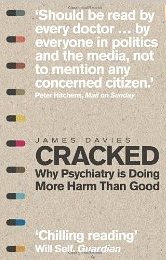
my current reading around psychiatry and mental health services.Most notably, I am presently reading a book
entitled Cracked: Why Psychiatry is Doing
More Harm than Good by James Davies (a fantastic read that I’d recommend to
everyone, although it makes my blood boil!).I don’t need to explain what it’s all about, since the title does a good
enough job of giving you the gist.
I was prompted to write this post when reading a chapter
that addresses cultural interpretations of emotional suffering and mental
distress, just one issue amongst the many revealed by Davies in the book.This particular topic, though, somehow struck
a chord with me in a way that inspired me to write about it first above
everything else, perhaps because of the personal significance it has for me as
well as the wider social and cultural questions it raises.As a result, what I think we’re going to end
up with is a piece that not only addresses one of the widest and deepest
cultural issues I’ve written about yet, but also one that is more personal and
self-disclosing than anything I have written previously. I hope it makes for a good read!
(Having already taken three paragraphs to introduce the
topic!) I’d like to start by posing some questions: what does emotional
suffering or mental distress mean to you?What function do you believe it plays, if any?Or is it just something that gets in the way
and needs to be gotten rid of as promptly as possible?In Cracked…,
Davies notes that in Western culture, mental suffering has come to be perceived
more and more as something that does not serve a purpose or function, and needs
to be removed by any means possible.Psychiatry
has purportedly contributed significantly to this perception, as I will explain
briefly now.
To give some context, one of the key objectives of Cracked is to expose the arbitrary and
corrupted nature by which mental illness is defined by psychiatry, and the
building of a mythical world in which mental distress is caused by some
physical or biological phenomenon.In
fact, what you’ll find if you dig deep is that there is actually no scientific
backing for this notion.However, as
psychiatry has gained power (largely though the financial rewards associated
with pharmaceutical industry links), the notion that mental distress is biologically
rooted has taken hold in our culture, therefore rendering mental suffering as a
result of abnormality, to be eradicated by psychiatric interventions (which
sadly almost inevitably means medication).
Mental distress: part of being human or bioliogical abnormailty?!
Eradicating suffering and emotional distress sounds great on
the surface, so one might argue that it’s wonderful that psychiatry offers a
solution to this.Aside from the fact
that there is little-to-no scientific backing for this approach (to be
discussed further in later posts!), there is another problem here.Before we started to view mental distress as
a sign of illness and abnormality, we relied much more heavily on psychological
and spiritual explanations and ways of coping.Addressing distress in this way, I believe, is far more productive.By recognising the causes of distress, often
traumatic events or general life stressors, we can also properly deal with the
problem rather than blunting it.Furthermore, we can learn and develop from the experience.As the aforementioned Mr Davies notes, “from
affliction there can be derived some unexpected gain, new perspective or
beneficial alteration”.
The above statement rings true and resonates with me, and I
feel uncomfortable with the fact that more and more suffering is being
medicalised and passed off as something to be blunted and controlled.More and more things that were once accepted
as a normal part of the human experience are now defined as symptoms of mental
illness.I feel that resilience is one of
the most important things in the maintenance of psychological wellbeing, and
the medicalisation of distress is not helping us to build a resilient and
mentally healthy population.
As already hinted at, I am of the school of thought that
distress can be learned from and help a person to develop and overcome life’s
challenges, and that this is being stifled unnecessarily and unhelpfully in
many cases by the current misguided tendency, through psychiatry, to associate
mental distress with biology.(To
illustrate my point: how many times have you heard the phrase ‘chemical
imbalance’ in relation to mental health?If you were to read Cracked,
you’d realise this is an unproven and therefore dangerous notion, which is why I
am so concerned by the view of suffering that psychiatry instils).
I’ll illustrate my own personal stance on this topic using a
combination of anecdote and music.As regular
readers will already know, I am a huge music fan and like to give each blog
post a lyrical title and refer to relevant music within my writing!
To quote a cliché and indeed song title, “what doesn’t kill
you makes you stronger”.And let’s be
honest, clichés generally materialise because there is an element of truth in
them to begin with.Most of us have
probably had times when we could really relate to this statement, times when we’ve
come through adversity feeling stronger than before.For me, the best example is a relationship
break-up I went through a few years ago.It felt like the worst thing ever at the time, like the pain would be
endless and insurmountable.Of course,
this wasn’t the case! As beautifully
articulated by Matt Cardle in his song Porcelain:
All the things in this
life that you thought you just couldn’t bear
It’s the pressure
inside makes the diamond that’s shining there
All the pain and the
heartache can break you and shape you like clay
Now you’ve come
through the fire and that makes you porcelain
It took a long time, but once I’d got over it I felt so much
better than I had whilst in the relationship.Not only this, but I realised that I’d learnt a lot and gained new
perspective on certain things.For me,
the gaining of perspective is perhaps the most important benefit of coming
through adversity and dealing with distress in a productive way.
Many people who have experienced bereavement will be able to
relate to the idea that such events, whilst horrendous, really have the power
to make us appreciate life, the world and, most importantly, the people around
us, more than we did before. I myself experienced
a significant bereavement during my teenage years: I am one of triplets, and
unfortunately one of my two brothers took his own life when we were just
14.Of course, this is a horrible thing
for my family to go through, but it has undoubtedly altered my perspective on
life and made me so much more grateful for my loved ones.Indeed it has probably also, on some
subconscious level, influenced my aspirations in life and driven some of my
passion for the very things I write about now.
Of course there are negatives as well: for instance, the
incredibly sudden and unexpected nature of the incident meant that for a while I
experienced high anxiety around thoughts of similar things happening again, and
still do to a certain extent.However, I
can now recognise this as a fairly normal, if slightly irrational, reaction to
a traumatic experience.If I were to
read the DSM (or Diagnostic and Statistical Manual of Mental Disorders, which lists
all the
conditions psychiatry has decided constitutes a mental disorder), I would
probably find that I could diagnose myself with several ‘disorders’ based on
this and other features of my personality, experiences and feelings.Since I have worked through these
difficulties and gained something from this, I hope you’ll agree that receiving
a diagnosis of a mental disorder would not have been helpful to me, but this is
what’s happening to people every day when they end up in mental health
services.
What worries me is that more and more normal human
experiences are being medicalised by psychiatrists.This is characterised by the fact that each
time the DSM is revised, the number of disorders it lists grows.This is surely serving to reduce our ability to
view distress as a normal part of human experience and enhancing our propensity
to view it as a sign of illness that must be treated.I find this thought quite scary, particularly
considering that the diagnostic criteria set out in the DSM are based on
nothing more scientific than the perceptions and discussions of a bunch of guys
who work for the APA (American Psychiatric Association).Anyway, I think I’m going off on a bit of a
tangent here, so I’ll leave it there for you to ponder if you wish, with the
promise of more on this in a later post.
I remember hearing a psychologist called Rachel Perkins
speaking at a mental health conference last year.There is one thing that she said that I
remember very well because it resonated with me at the time, and I’m glad I
remembered it because it is even more poignant for me now!She noted that culturally we have come to
rely on ‘experts’ (ie healthcare professionals, psychiatrists, etc.) to deal
with our distress for us.Why has this
happened?Shouldn’t we all in fact be the
experts in managing our own distress and helping those around us to do the
same?I would agree with Ms Perkins that
the answer is yes, we should be turning more often to ourselves and our support
networks and less often to medicine to deal with normal human suffering.
I myself am a big advocate of using support networks to
overcome challenging times.Yes, I’m
incredibly fortunate to be blessed with a wonderful family and great friends,
where others aren’t so lucky.But that’s
what support groups and such like are for, and all the more reason to invest more
money in community-based, non-medical approaches to wellbeing, over medication
and hospitalisation.It’s amazing how
beneficial a good chinwag can be, whether this be with a friend, family member,
counsellor, support group, teacher,
Coffee and a chat: Something I find very therapeutic!
hairdresser, or a stranger you met on the
bus!
To me, it makes so much more sense to take this positive
view of emotional suffering, to work through it and gain something from it,
rather than demonising and abnormalising it (abnormalising isn’t actually a
word but I’m using it anyway as it sounds good in this context!).I’m not suggesting this is true for all cases
of suffering because of course there are times when people are so severely distressed
that a more intensive form of intervention is needed.My point is that as psychiatry and the social
constructs of mental illness grow, so does the perception of distress as
abnormal, which I suggest is not a healthy feature of modern society.
To lighten things up a bit, I’ll give you a few more
anecdotes about my own ways of dealing with distress.In previous posts I’ve talked about lifestyle
elements and their impact on wellbeing, but I also use simple thinking processes
to work through emotional difficulties.
Something I actually find very helpful is, when I’m feeling
really low or anxious, to consciously tell myself that this is a normal part of
the human experience, or an understandable reaction to whatever is going on in
my life at the time.I find that this
helps to ground me and perhaps to start problem solving whatever the problem is,
which in turn helps me to steer clear of turning to ‘professionals’ for support
that I don’t actually need.I think
there’s also something to be said for taking some of that distress and turning
it into something positive, for example, channelling anger or hurt over an
unfortunate experience into working harder to achieve my goals. Another thing I find useful is to remember
that without the bad times there wouldn’t really be good times either: in the
words of Thomas Hardy, “If a way to the better there be, it first exacts a full
look at the worst”; or, as Matt Cardle puts it, “The stairway to heaven, oh it
starts in hell”.
If the above and other coping strategies don’t quite work as
well as I need them to, then I know there are options available for further support,
and have indeed made use of input from counsellors and psychologists in the
past (I’m not completely adverse to the use of services and hope it doesn’t appear
that way from what I’ve said here.If it
does, then be assured that this is only because I feel so passionately that the
alternatives need greater attention!)
There is a fine balance to be struck between developing the
right services, education and awareness (along with stigma reduction) so that
people can access the support they need when they need it, and not becoming
overly reliant on such support, which culturally we are in danger of doing.Unfortunately there is a lot of work still to
be done on all these fronts, and getting each one of those things to the level
they need to be at is a very tall order (and once which I hope I can make a
worthwhile contribution to fulfilling!).
To summarise, there are two main ways of perceiving mental
distress and emotional suffering:the
positive view that it is a natural part of the human experience that can
ultimately be gained from, and the negative view that it is the result of some
kind of abnormality of the brain or biology.There is some place for both, but as psychiatry has grown the negative
view has seeped stealthily into our culture, leaving less and less room for the
positive one.I myself am an advocate of
favouring the positive view a little more, and I’ll finish by leaving you with a
couple of songs that depict my stance on the topic quite nicely.Thanks for reading!