My thoughts on all things health and wellbeing. Contact me for writing services and visit my main website www.laurenscloud.com
lauren.bishop123@btinternet.com
A slightly early Happy Valentine’s Day to one and all!Whether you’re a singleton, part of a happy
couple, have been married forever, a serial dater, or suffering from heartbreak,
I reach out and wish you joy on the annual day of love!
Valentine’s Day seems to have become a big deal for a lot of
people, seemingly more so every year.Whilst
I can see it’s appeal, it also has its downsides, so overall I have mixed
feelings about the whole thing.Here’s
my take on the ups and downs of V-Day:
Every year, as the middle of February comes around, I find
it a little baffling that so many people talk about how depressing it is to be
single on Valentine’s Day.This is
probably in part because I don’t really get the concept to begin with: it’s
over-commercialised.It’s seen as a
great night to go out but all the nice places to eat and drink are packed and
noisy.Also, I don’t see why we should
subscribe to being romantic on a set day of the year!Why not express appreciation for loved ones
every day of the year?!
That said, I don’t want to come across as having a ‘bah-humbug’
type of attitude to Valentine’s Day.Of course
it’s nice to have an excuse to spoil our loved ones, spend quality time
together and get romantic.But why feel
down if you’re not in a romantic relationship?I for one have only ever been with someone one Valentine’s Day once, in
the quarter of a century I’ve spent on the planet, and I can’t say it’s ever
bothered me too much!
The one time I did ‘do Valentine’s Day’, I still didn’t
really do it properly, so to speak.There
was a romantic meal, but we did this the weekend after the day itself, avoiding
the overcrowding that I can only assume occurs on the day itself.Other than that, the whole thing was a little
disappointing: I’d bought some lovely goodies for my at-the-time-boyfriend,
despite being a poor student, and in return got a couple of tacky gifts that
had probably been bought at a service station on the way to seeing me!Not so romantic after all!
Anyway, this doesn’t make me bitter or anything, it just
makes me think the whole occasion is a bit over-hyped, which I guess a lot of
people will agree with.Also, I’m quite
pleased to be able to say I was once given a red rose on V-Day.I was still at school and must’ve been about
16.A charming male friend of mine had
bought about half a dozen red roses and handed them out to his nearest and
dearest female friends.A lovely touch,
and something that’s remained vividly in my memory for all these years!
Fun with friends! :)
This nicely illustrates my main point, which is this: to me,
there’s no point in getting down about being single on V-Day (I’m bored of
typing Valentine’s!); instead, why not show some extra love and appreciation to
others you hold dear?!Let us singletons
turn a would-be-disheartening occasion into a celebration of being single and free
to enjoy time with our friends!
I’m thinking a picnic in the park with my friends this
Saturday will do the trick: for couples, this can be quite a romantic activity,
but this will be with the added bonus of greater numbers (the more the merrier
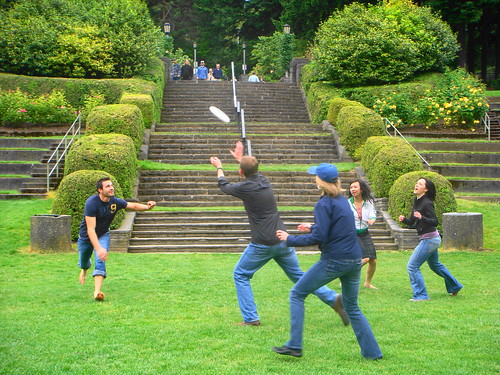
& all that!) AND made more fun by a spot of Frisbee!Who’s in?!
Share the love this Valentine's Day, even if you're single!
If it rains, let’s go to the pub instead.Can’t go wrong, right?!
Anyway, that’s all from me for now.Whatever you’re doing, I hope you have a
delightful time this weekend, with whichever loved one (or ones) you
choose.If you’re the type to feel a
little low at this time of year, I challenge you to flip that switch, turn a
negative into a positive and celebrate single life!
Welcome to my little, What I Call, Christmas Special blog
post (Miranda Hart fans will no doubt appreciate this opening :)).
It’s a time of year for joy and fun,
food and drink, family and friends, and appreciating all the good things life
and the world have to offer.Of course
those of a certain religious status may find it offensive that I’ve said that,
but honestly for me that’s what Christmas is and has been all my life; it’s not
that I don’t appreciate the religious origins of Christmas, but I don’t have
any qualms with admitting I’m not religious myself.However, I think some of my own values when
it comes to Christmas match the Christian ones: it should be a time for
forgiveness, thankfulness and peace; this I hope is something we can all agree
on, no matter what our religious backgrounds.
As I’ve already hinted at, for me, spending time with family
and friends is pretty much the most important thing about Christmas.In my last post I spoke about mindfulness,
about taking more time to notice what’s going on and how I’m feeling in everyday
situations.This had led me to really
think about and take note of the dynamics between people in different types of
relationships, and at this time of year when many of us come together with
family and friends, I thought it’d be fun to note some of my observations on
relationships.
The first is that parents can be so mean and unreasonable to their kids! When I was at the Track Cycling World Cup a
couple of weekends ago (see my post That’sHow a Superhero Learns to Fly), there was a dad sat next to me with his
young boy.The kid managed to spill his
lemonade all over the floor, and the dad went nuts at him: “you STUPID boy, I
can’t believe you’ve done that, you need to be more careful…!!!”.Many of us can probably remember being shouted
at as kids for spilling things, but observing the situation as an
I've noticed parents shout at their kids for the silliest reasons!
outsider I found
this guy’s reaction a little absurd: of course the kid didn’t mean to spill the drink and of course he
was trying not to spill it (he surely
wanted to drink it, after all).It seems
ridiculous that a parent gets so angry with a child for what is clearly a
simple mistake that we all make.He probably
wouldn’t have dreamed of shouting at his friend in the pub for spilling a
drink, or at his wife if she’d spilt or dropped something in the house!
I had a similar experience today in M&S where a girl
walked past a pile of boxes of Christmas crackers and a couple of them fell
over.Her dad: “WHAT HAVE YOU DONE?Pick those up; what have you done?!!!”.She said it wasn’t her that had knocked them over;
I’m not sure whether this was the case or not but even if she had, once again
her dad’s reaction was so over the top relative to the situation and the damage
that had (or more to the point hadn’t!) been done.
Having a laugh with friends: one of life's true joys!
My next observation is how within pairs or groups of friends,
you can say and do things which would be completely meaningless or plain weird
to an outsider but make perfect sense to you and your friend.Of course this is the case with in jokes,
which we always have to be careful not to use out of context: as a result of a
habit of one of my best friends from uni, who I lived with, several years on I
find myself tempted to say “good luck; don’t miss” every time someone informs
me they’re off to the toilet!Another great
one is how me and another of my best friends from uni can have the following
interaction: Me: “Umm…” Her: “Yeah” Me: “Ok” Her: “Cool” and we’ve genuinely
had a meaningful conversation with a tangible outcome.Brilliant!
Another thing I love about friendship is how there are some
people you don’t see or even speak to for months or years, and when you do get
together it’s like you were never apart.Believe it or not, until a couple of weeks ago I hadn’t seen either of
the girls I live next door to properly for well over a year!In my defence, myself and one of the other
girls had both been living elsewhere for quite a bit of that time, but even so,
there’s no excuse for us not seeing each other for so long!But the amazing thing about my relationship
with these girls is that we’re almost like family: I’ve lived in this house (on
and off) for twelve years (that’s half my life, since I was twelve years old!),
so we’ve kind of grown up together, and undeniably been through a lot as a
group.So when we do see each other we
have a lovely time and chat for hours and hours, which makes all the time apart
worth it.Lovely.
We should be kind to ourselves at Christmas without stressing about work or stidies
At this special time of year, I’m making an extra big effort
to really appreciate my family and friends.I’m fortunate enough to have a couple of weeks off work so I really have
a lot of time to spend with them, and I’m using mindfulness (see my previous
post!) to make the most of it.Something
else I’m using Christmas as a good reason for is simply being kind to myself,
which is something I think most of us overlook, not just over the festive period
but all year round.I don’t just mean
looking after ourselves by eating healthily and exercising (I’m the first to
admit this type of thing largely goes downhill for me over Christmas!) but
treating ourselves in a friendly and compassionate manner (for instance not
feeling bad about exercise and eating going out the window for a few days!).Many students, particularly at this time of
year, will know the horrible situation of being constantly in one of two
less-than-enjoyable states: either studying, or feeling guilty for not
studying, which leads to never feeling truly relaxed.It’s important to schedule in recreation and
leisure time whatever else you’ve got going on, and to make sure you switch off
those feelings of guilt and really enjoy relaxation time to the max.
Essentially what I’m saying is, the way I see it, Christmas is
all about truly enjoying yourself and appreciating life (not that you shouldn’t
do this all year round!). This might
mean making some alterations in order to achieve this.For example, going back to my observations
about dynamics between families and friendship groups, if you start to notice
certain things that are positive and negative about your own relationships you’ll
appreciate the good bits more and have some insight as to how to change the
negatives.Come to think of it, the same
can be said for any aspects of life: the more you are aware of your feelings,
thoughts and surroundings, the more you can learn about what you need to do to
improve your life, and which bits don’t need improving because they’re already
good!
To conclude, I want everyone to have a great Christmas and
New Year period, and hope for some this post will provide some helpful tips for
maximum enjoyment, or at least makes for a good read.One final tip I’d give is don’t try too hard to enjoy Christmas.I’ve been guilty of trying to force myself to
enjoy things on occasions and it just doesn’t work.Instead, focus on consciously noticing and
being aware, and enjoyment and happiness will naturally follow.
Thanks as always for reading; please make my Christmas extra
special by sharing my blog to help to boost my readership .It’s here to be read by as many people as
possible after all; that’s why I write it! And finally, I’d like to wish all my readers
the merriest, happiest and healthiest of Christmases.Eat, drink and be merry!
"The consciousness of loving and being loved brings a warmth and richness to life that nothing else can bring"
Oscar Wilde
Hello readers, and welcome to the latest instalment of On My
Cloud, where I like to ramble on about things I feel strongly about!I say ramble partly in jest, as I hope that
in reality the things I say are considered valuable by others too and strike a
chord with at least some readers.The
reason I write this blog at all is that I feel the things I’m writing about are
incredibly important and need to be in public awareness, so as always I welcome
and encourage comments and sharing with others who may be interested in what I
have to say. (Thanks!)
Having experienced a few dry spells with my writing, at the
moment I’m a bit inundated with ideas for things to write about, largely due to
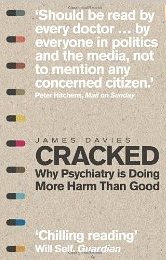
my current reading around psychiatry and mental health services.Most notably, I am presently reading a book
entitled Cracked: Why Psychiatry is Doing
More Harm than Good by James Davies (a fantastic read that I’d recommend to
everyone, although it makes my blood boil!).I don’t need to explain what it’s all about, since the title does a good
enough job of giving you the gist.
I was prompted to write this post when reading a chapter
that addresses cultural interpretations of emotional suffering and mental
distress, just one issue amongst the many revealed by Davies in the book.This particular topic, though, somehow struck
a chord with me in a way that inspired me to write about it first above
everything else, perhaps because of the personal significance it has for me as
well as the wider social and cultural questions it raises.As a result, what I think we’re going to end
up with is a piece that not only addresses one of the widest and deepest
cultural issues I’ve written about yet, but also one that is more personal and
self-disclosing than anything I have written previously. I hope it makes for a good read!
(Having already taken three paragraphs to introduce the
topic!) I’d like to start by posing some questions: what does emotional
suffering or mental distress mean to you?What function do you believe it plays, if any?Or is it just something that gets in the way
and needs to be gotten rid of as promptly as possible?In Cracked…,
Davies notes that in Western culture, mental suffering has come to be perceived
more and more as something that does not serve a purpose or function, and needs
to be removed by any means possible.Psychiatry
has purportedly contributed significantly to this perception, as I will explain
briefly now.
To give some context, one of the key objectives of Cracked is to expose the arbitrary and
corrupted nature by which mental illness is defined by psychiatry, and the
building of a mythical world in which mental distress is caused by some
physical or biological phenomenon.In
fact, what you’ll find if you dig deep is that there is actually no scientific
backing for this notion.However, as
psychiatry has gained power (largely though the financial rewards associated
with pharmaceutical industry links), the notion that mental distress is biologically
rooted has taken hold in our culture, therefore rendering mental suffering as a
result of abnormality, to be eradicated by psychiatric interventions (which
sadly almost inevitably means medication).
Mental distress: part of being human or bioliogical abnormailty?!
Eradicating suffering and emotional distress sounds great on
the surface, so one might argue that it’s wonderful that psychiatry offers a
solution to this.Aside from the fact
that there is little-to-no scientific backing for this approach (to be
discussed further in later posts!), there is another problem here.Before we started to view mental distress as
a sign of illness and abnormality, we relied much more heavily on psychological
and spiritual explanations and ways of coping.Addressing distress in this way, I believe, is far more productive.By recognising the causes of distress, often
traumatic events or general life stressors, we can also properly deal with the
problem rather than blunting it.Furthermore, we can learn and develop from the experience.As the aforementioned Mr Davies notes, “from
affliction there can be derived some unexpected gain, new perspective or
beneficial alteration”.
The above statement rings true and resonates with me, and I
feel uncomfortable with the fact that more and more suffering is being
medicalised and passed off as something to be blunted and controlled.More and more things that were once accepted
as a normal part of the human experience are now defined as symptoms of mental
illness.I feel that resilience is one of
the most important things in the maintenance of psychological wellbeing, and
the medicalisation of distress is not helping us to build a resilient and
mentally healthy population.
As already hinted at, I am of the school of thought that
distress can be learned from and help a person to develop and overcome life’s
challenges, and that this is being stifled unnecessarily and unhelpfully in
many cases by the current misguided tendency, through psychiatry, to associate
mental distress with biology.(To
illustrate my point: how many times have you heard the phrase ‘chemical
imbalance’ in relation to mental health?If you were to read Cracked,
you’d realise this is an unproven and therefore dangerous notion, which is why I
am so concerned by the view of suffering that psychiatry instils).
I’ll illustrate my own personal stance on this topic using a
combination of anecdote and music.As regular
readers will already know, I am a huge music fan and like to give each blog
post a lyrical title and refer to relevant music within my writing!
To quote a cliché and indeed song title, “what doesn’t kill
you makes you stronger”.And let’s be
honest, clichés generally materialise because there is an element of truth in
them to begin with.Most of us have
probably had times when we could really relate to this statement, times when we’ve
come through adversity feeling stronger than before.For me, the best example is a relationship
break-up I went through a few years ago.It felt like the worst thing ever at the time, like the pain would be
endless and insurmountable.Of course,
this wasn’t the case! As beautifully
articulated by Matt Cardle in his song Porcelain:
All the things in this
life that you thought you just couldn’t bear
It’s the pressure
inside makes the diamond that’s shining there
All the pain and the
heartache can break you and shape you like clay
Now you’ve come
through the fire and that makes you porcelain
It took a long time, but once I’d got over it I felt so much
better than I had whilst in the relationship.Not only this, but I realised that I’d learnt a lot and gained new
perspective on certain things.For me,
the gaining of perspective is perhaps the most important benefit of coming
through adversity and dealing with distress in a productive way.
Many people who have experienced bereavement will be able to
relate to the idea that such events, whilst horrendous, really have the power
to make us appreciate life, the world and, most importantly, the people around
us, more than we did before. I myself experienced
a significant bereavement during my teenage years: I am one of triplets, and
unfortunately one of my two brothers took his own life when we were just
14.Of course, this is a horrible thing
for my family to go through, but it has undoubtedly altered my perspective on
life and made me so much more grateful for my loved ones.Indeed it has probably also, on some
subconscious level, influenced my aspirations in life and driven some of my
passion for the very things I write about now.
Of course there are negatives as well: for instance, the
incredibly sudden and unexpected nature of the incident meant that for a while I
experienced high anxiety around thoughts of similar things happening again, and
still do to a certain extent.However, I
can now recognise this as a fairly normal, if slightly irrational, reaction to
a traumatic experience.If I were to
read the DSM (or Diagnostic and Statistical Manual of Mental Disorders, which lists
all the
conditions psychiatry has decided constitutes a mental disorder), I would
probably find that I could diagnose myself with several ‘disorders’ based on
this and other features of my personality, experiences and feelings.Since I have worked through these
difficulties and gained something from this, I hope you’ll agree that receiving
a diagnosis of a mental disorder would not have been helpful to me, but this is
what’s happening to people every day when they end up in mental health
services.
What worries me is that more and more normal human
experiences are being medicalised by psychiatrists.This is characterised by the fact that each
time the DSM is revised, the number of disorders it lists grows.This is surely serving to reduce our ability to
view distress as a normal part of human experience and enhancing our propensity
to view it as a sign of illness that must be treated.I find this thought quite scary, particularly
considering that the diagnostic criteria set out in the DSM are based on
nothing more scientific than the perceptions and discussions of a bunch of guys
who work for the APA (American Psychiatric Association).Anyway, I think I’m going off on a bit of a
tangent here, so I’ll leave it there for you to ponder if you wish, with the
promise of more on this in a later post.
I remember hearing a psychologist called Rachel Perkins
speaking at a mental health conference last year.There is one thing that she said that I
remember very well because it resonated with me at the time, and I’m glad I
remembered it because it is even more poignant for me now!She noted that culturally we have come to
rely on ‘experts’ (ie healthcare professionals, psychiatrists, etc.) to deal
with our distress for us.Why has this
happened?Shouldn’t we all in fact be the
experts in managing our own distress and helping those around us to do the
same?I would agree with Ms Perkins that
the answer is yes, we should be turning more often to ourselves and our support
networks and less often to medicine to deal with normal human suffering.
I myself am a big advocate of using support networks to
overcome challenging times.Yes, I’m
incredibly fortunate to be blessed with a wonderful family and great friends,
where others aren’t so lucky.But that’s
what support groups and such like are for, and all the more reason to invest more
money in community-based, non-medical approaches to wellbeing, over medication
and hospitalisation.It’s amazing how
beneficial a good chinwag can be, whether this be with a friend, family member,
counsellor, support group, teacher,
Coffee and a chat: Something I find very therapeutic!
hairdresser, or a stranger you met on the
bus!
To me, it makes so much more sense to take this positive
view of emotional suffering, to work through it and gain something from it,
rather than demonising and abnormalising it (abnormalising isn’t actually a
word but I’m using it anyway as it sounds good in this context!).I’m not suggesting this is true for all cases
of suffering because of course there are times when people are so severely distressed
that a more intensive form of intervention is needed.My point is that as psychiatry and the social
constructs of mental illness grow, so does the perception of distress as
abnormal, which I suggest is not a healthy feature of modern society.
To lighten things up a bit, I’ll give you a few more
anecdotes about my own ways of dealing with distress.In previous posts I’ve talked about lifestyle
elements and their impact on wellbeing, but I also use simple thinking processes
to work through emotional difficulties.
Something I actually find very helpful is, when I’m feeling
really low or anxious, to consciously tell myself that this is a normal part of
the human experience, or an understandable reaction to whatever is going on in
my life at the time.I find that this
helps to ground me and perhaps to start problem solving whatever the problem is,
which in turn helps me to steer clear of turning to ‘professionals’ for support
that I don’t actually need.I think
there’s also something to be said for taking some of that distress and turning
it into something positive, for example, channelling anger or hurt over an
unfortunate experience into working harder to achieve my goals. Another thing I find useful is to remember
that without the bad times there wouldn’t really be good times either: in the
words of Thomas Hardy, “If a way to the better there be, it first exacts a full
look at the worst”; or, as Matt Cardle puts it, “The stairway to heaven, oh it
starts in hell”.
If the above and other coping strategies don’t quite work as
well as I need them to, then I know there are options available for further support,
and have indeed made use of input from counsellors and psychologists in the
past (I’m not completely adverse to the use of services and hope it doesn’t appear
that way from what I’ve said here.If it
does, then be assured that this is only because I feel so passionately that the
alternatives need greater attention!)
There is a fine balance to be struck between developing the
right services, education and awareness (along with stigma reduction) so that
people can access the support they need when they need it, and not becoming
overly reliant on such support, which culturally we are in danger of doing.Unfortunately there is a lot of work still to
be done on all these fronts, and getting each one of those things to the level
they need to be at is a very tall order (and once which I hope I can make a
worthwhile contribution to fulfilling!).
To summarise, there are two main ways of perceiving mental
distress and emotional suffering:the
positive view that it is a natural part of the human experience that can
ultimately be gained from, and the negative view that it is the result of some
kind of abnormality of the brain or biology.There is some place for both, but as psychiatry has grown the negative
view has seeped stealthily into our culture, leaving less and less room for the
positive one.I myself am an advocate of
favouring the positive view a little more, and I’ll finish by leaving you with a
couple of songs that depict my stance on the topic quite nicely.Thanks for reading!

 The one time I did ‘do Valentine’s Day’, I still didn’t
really do it properly, so to speak. There
was a romantic meal, but we did this the weekend after the day itself, avoiding
the overcrowding that I can only assume occurs on the day itself. Other than that, the whole thing was a little
disappointing: I’d bought some lovely goodies for my at-the-time-boyfriend,
despite being a poor student, and in return got a couple of tacky gifts that
had probably been bought at a service station on the way to seeing me! Not so romantic after all!
The one time I did ‘do Valentine’s Day’, I still didn’t
really do it properly, so to speak. There
was a romantic meal, but we did this the weekend after the day itself, avoiding
the overcrowding that I can only assume occurs on the day itself. Other than that, the whole thing was a little
disappointing: I’d bought some lovely goodies for my at-the-time-boyfriend,
despite being a poor student, and in return got a couple of tacky gifts that
had probably been bought at a service station on the way to seeing me! Not so romantic after all!